Have You Outgrown Your EA Role?
You’re good at your job.
So they keep giving you more.
At first, the work may have been familiar: calendar, communication, priorities, administration.
Then came more information to manage. More follow-up. More cross-department coordination. More responsibility for making sure things didn’t fall through the cracks.
Your job changed.
Your title may not have.
You may now be responsible for work across the organization without having direct authority over the people involved. You follow up. You remind. You coordinate. And when something still isn’t moving, you find yourself saying, “I need this for Rick.”
That’s not a complaint. That’s a description of the job you’re actually doing.
Have you unintentionally become a Chief of Staff?
Ask yourself three questions:
Do other departments come to you first, before they go to your executive directly?
Are you the one who has to make sure something actually happens, even when it’s not your job to make anyone do it?
Have you ever gotten further by stating who made the request than by explaining why it was critical?
If you answered yes to at least two, you may already be functioning less like an Executive Assistant and more like a Chief of Staff.
That does not automatically mean you need a new title.
It does mean the work deserves clarity.
An Executive Assistant manages and supports the executive’s work.
A Chief of Staff coordinates organizational work on behalf of the executive.
The role was not redesigned on purpose. It happened one delegated responsibility at a time.
You succeed, so you earn more trust.
More trust creates more responsibility.
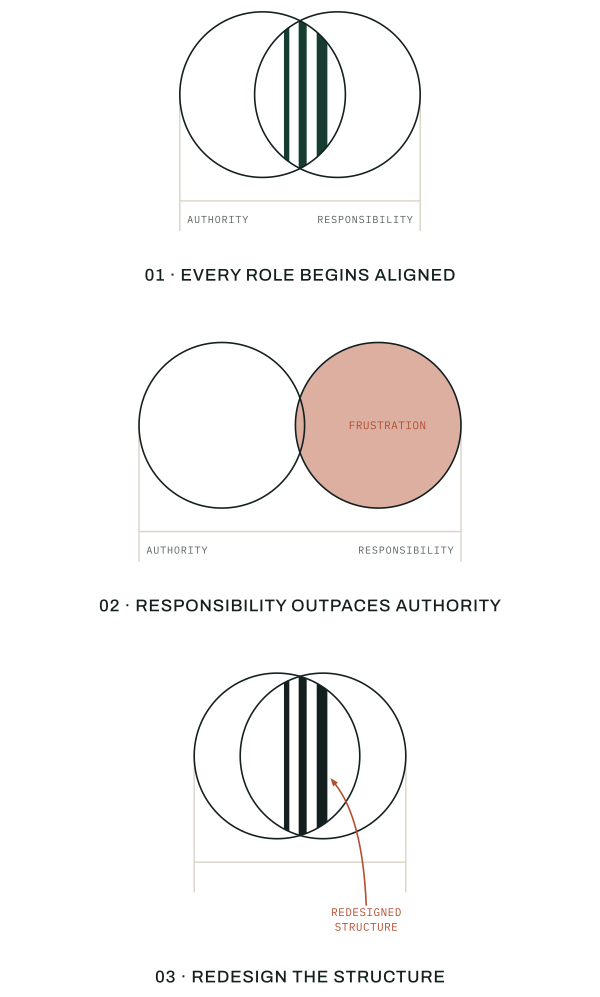
Eventually, your responsibility may have changed while your authority has not.
That’s where the frustration comes from
You need something from another leader.
You ask.
Nothing happens.
You follow up.
Still nothing.
So you invoke the executive’s name.
Sometimes that works.
Sometimes it still doesn’t.
Now you’re responsible for an outcome you cannot consistently produce through either your own authority or the authority you borrow.
That tension wears on you.
You may wonder how hard to push, when to escalate, whether you are overstepping, or whether bringing the issue back to your executive means you failed.
Meanwhile, other leaders may feel managed by someone they do not believe has authority over them.
The problem may not be your capability.
It may be the structure around your role.
Your success may have created the very frustration you are now experiencing.
Your capability expanded.
Your responsibility expanded.
Your organizational reach expanded.
The structure didn’t.
That’s a structural gap, not a capability gap.
Don’t start with the title
The first conversation should not be, “I think I should be Chief of Staff.”
Start with the work.
What responsibilities are you carrying now that were not part of the role when you began?
Where are you coordinating work across departments?
What follow-through are you expected to produce from people who do not report to you?
When are you acting with your own authority, and when are you borrowing the authority of the executive you support?
Those questions reveal the actual issue.
The answer may be a Chief of Staff title.
It may be clearer authority within your existing role.
It may mean moving some responsibilities elsewhere.
And if administrative work is consuming capacity that is now needed for higher-level organizational work, some of that work may need to move down.
The goal isn’t the title.
It’s aligning the work you’re being asked to do with the authority and structure you need to do it well.
Sometimes frustration is evidence that a role is failing.
But sometimes it is evidence that you have succeeded beyond the role as it was originally designed.
That distinction matters.
If this describes your experience, you now have language for the gap:
Responsibility has outpaced authority.
That gives you something more useful to discuss than frustration alone.
And if you want to understand the other side of this conversation, I wrote the companion piece for the executive you support: Your EA May Have Outgrown the Role.
If this is one of the first structural misalignments you’ve been able to name, there are almost certainly others. The VennCo Organizational Assessment is built to surface them.