Your EA May Have Outgrown the Role
Your EA is frustrated.
People don’t respond. She’s forced to use your name often—and even then, she’s occasionally ghosted.
And you’re wondering why everyone else seems frustrated with her.
She is one of the most effective people on your team. She has earned your trust—and in your mind, deserves the team’s. You give her more because she gets things done, and she has taken more and more off your plate.
Her success has reduced your frustration while increasing hers—and sometimes everyone else’s.
Has your EA become your Chief of Staff?
Answer three questions:
Does your EA regularly coordinate work across departments on your behalf?
Is your EA responsible for getting follow-through from people who do not report to her?
Does your EA regularly need to use your name or authority to get that work done?
If you answered yes to at least two, you may have an EA who is already functioning as a Chief of Staff.
The problem is that your organization may still be treating her like an Executive Assistant.
An Executive Assistant manages and supports the executive’s work.
A Chief of Staff coordinates organizational work on behalf of the executive.
That transition can happen without anyone intentionally designing it. You give your EA more responsibility because she is competent. She succeeds, so you trust her with more.
Eventually, she isn’t simply managing your calendar, information, and priorities. She is coordinating work between departments, following up with leaders, and making sure organizational commitments actually happen.
Her responsibility changed.
Her authority may not have.
Responsibility without authority creates frustration.
You expect her to get something done across the organization.
She asks.
Nothing happens.
She follows up.
Still nothing.
Then she says, “Rick needs this.”
Sometimes it moves.
Sometimes it still doesn’t.
What changed? Not the request. The authority attached to it.
And when even your name doesn’t move the work, the frustration compounds.
She is responsible for the outcome, but neither her own authority nor the authority she borrows from you consistently produces follow-through.
That is the structural problem.
That may be perfectly normal occasionally. But when the role depends on repeatedly borrowing your authority, friction is almost inevitable.
She feels accountable without authority. Other leaders feel managed by someone they don’t believe has authority over them. And when she inevitably brings something back to you, she may feel like she failed—even though the structure never gave her what she needed to succeed.
I know. I got this wrong too.
The workaround kept working, mostly. That made it easy to leave the underlying problem alone.
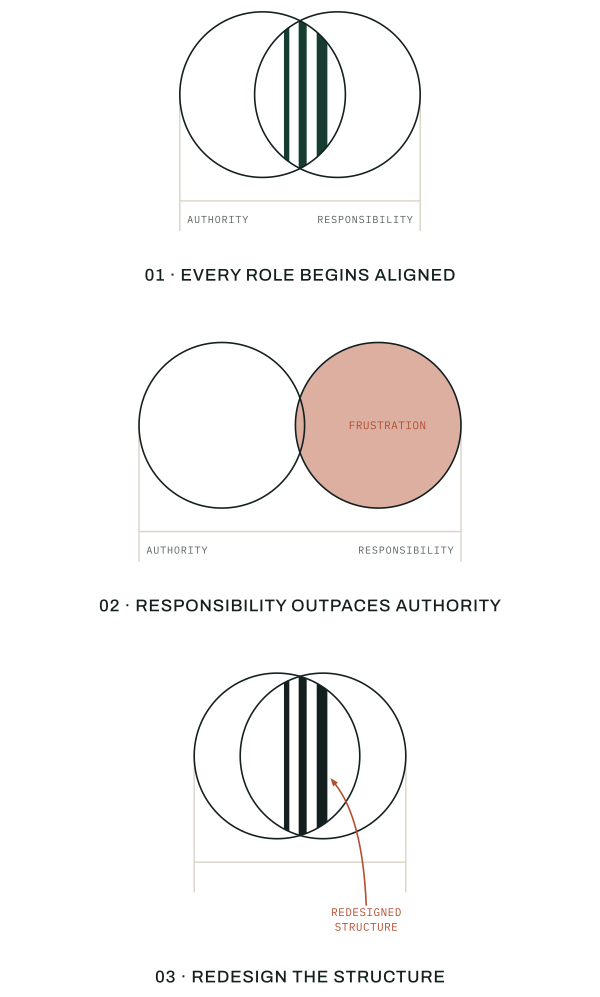
Fix the structure.
If your EA has functionally become a Chief of Staff, align the structure with the reality.
Expect the team to follow her cross-department coordination.
Define the follow-through she can require from people outside her reporting line.
Stop making her borrow your name every time she needs the organization to move.
Then tell the organization.
And if administrative work is still consuming her capacity, move that work down.
The goal isn’t a new title.
It’s providing the structure to align responsibility and authority.
Because this was never really an EA problem.
Her capability expanded.
Her responsibility expanded.
Her organizational reach expanded.
The structure didn’t.
Success created misalignment.
One of the principles behind our work at VennCo is: Expansion reveals the limitations that make innovation essential.
So the question is not simply whether your EA has become your Chief of Staff.
It’s whether her success has outgrown your structure.
Answer the three questions again, honestly. If you said yes two or three times, you may have a structure problem—not a people problem.
If you’ve navigated this—retitled the role, redefined authority, or decided against it—I’d be interested to hear what you found.
I wrote the other side of this conversation for the EA you support: Have You Outgrown Your EA Role?
If this article describes your organization, the companion piece may help start the conversation from her side.
And if this is one of the first misalignments you’ve named, there are almost certainly others. That’s what the VennCo Organizational Assessment is built to surface.